
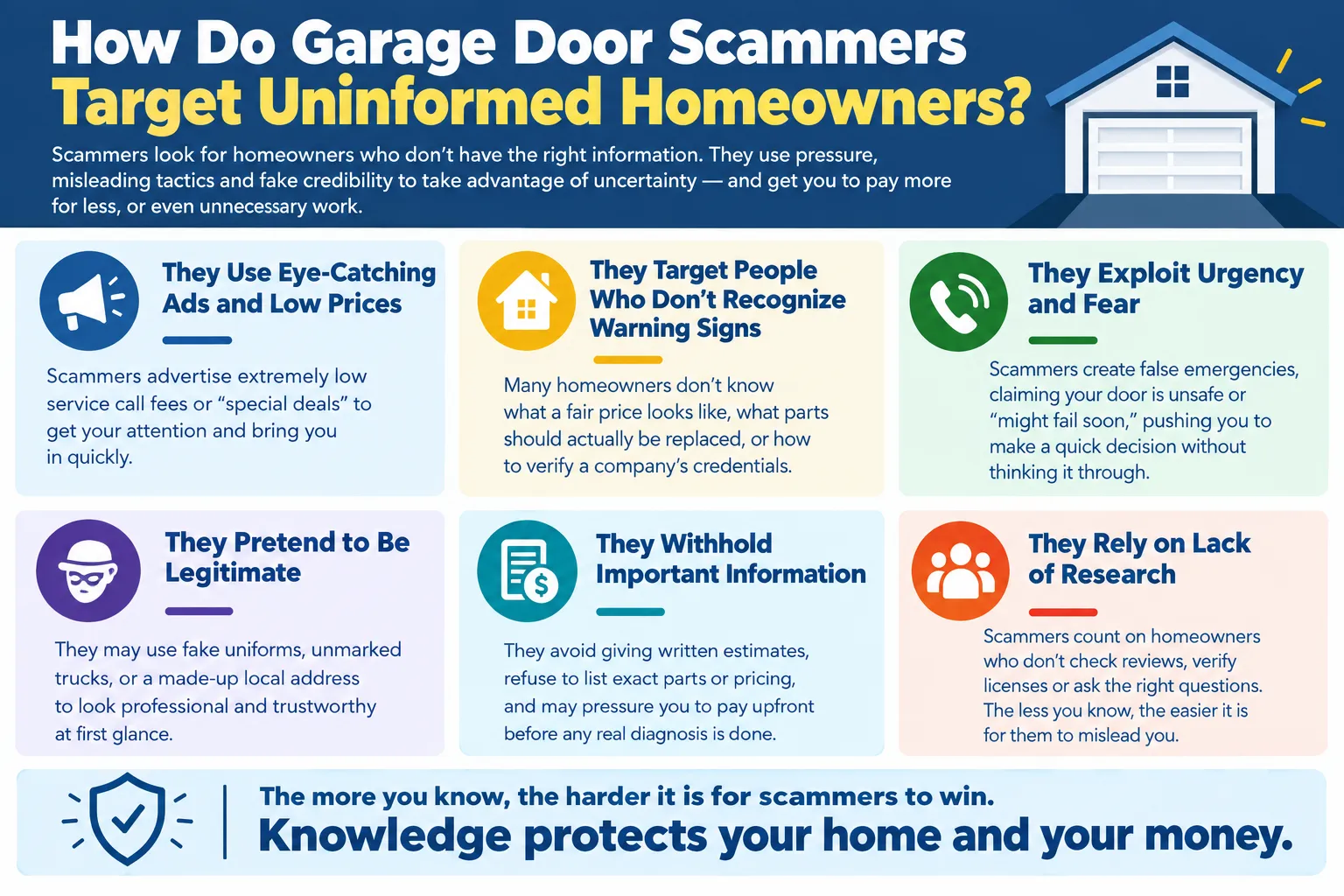
Scammers target uninformed homeowners by exploiting knowledge gaps across digital searches, on-site visits, and financial pressure tactics designed to work best on someone unfamiliar with the process. Understanding how that targeting works from start to finish removes most of the advantage scammers rely on.
Booking garage door service often happens quickly after something breaks, and that speed is precisely what fraudulent operators count on. This guide breaks down the specific tactics scammers use to identify and pursue vulnerable homeowners, from the first search result to the final invoice.
Key Takeaways
- Fake local listings and hijacked search results often reach homeowners before a real, established business ever does.
- Unmarked vehicles and unnamed subcontractors make it difficult to hold anyone accountable after a scam.
- Scammers exploit a lack of mechanical knowledge through inflated diagnoses and phantom part replacements.
- Psychological pressure and financial coercion work together to prevent a homeowner from pausing to verify anything.
- Recognizing these tactics early removes the advantage scammers depend on to succeed.
The Tactics Scammers Use to Target Homeowners
Fraud works in stages, moving from online deception to in-person pressure while adjusting based on how a homeowner responds.
Targeting Method | What It Looks Like | Why Homeowners Fall For It |
Digital infiltration | Fake local listings and hijacked search results | Search rankings feel trustworthy by default |
On-site obscurity | Unmarked vehicles and unnamed subcontractors | Identity rarely gets questioned once someone arrives |
Knowledge exploitation | Inflated diagnoses for parts that work fine | Few homeowners can verify a technical claim |
Psychological pressure | Fear tactics paired with false urgency | Fear shortens the time spent thinking clearly |
Financial coercion | Vague estimates and untraceable payment demands | Cash and app payments remove any paper trail |
A homeowner who stops to ask even one direct question at any point makes it far harder for a scammer to keep the deception going for long.
Digital Infiltration
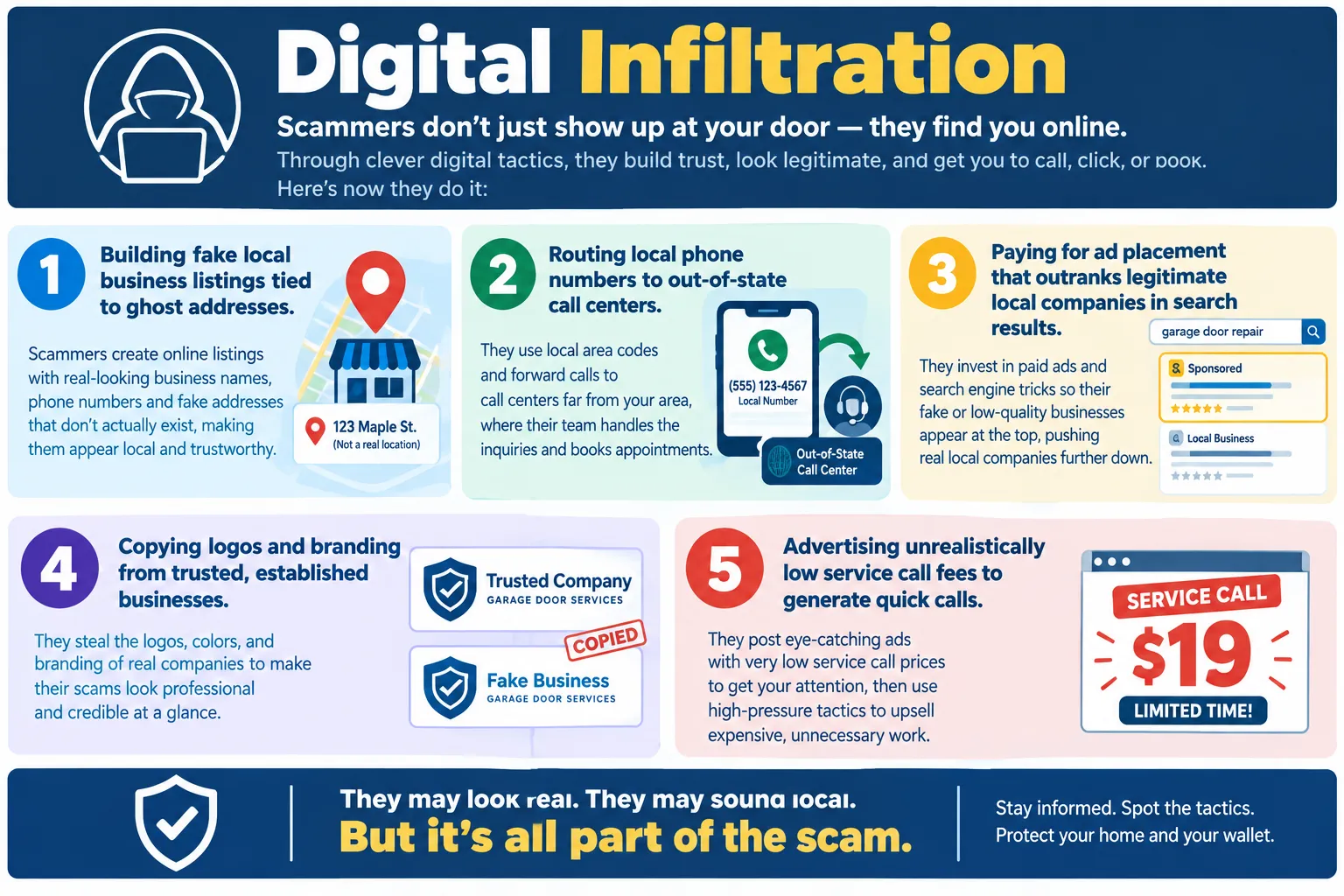
Fraudulent operators build an online presence long before a homeowner ever picks up the phone, using fake listings and impersonation to intercept real calls.
These digital tactics show up across nearly every reported case:
- Building fake local business listings tied to ghost addresses.
- Routing local phone numbers to out-of-state call centers.
- Paying for ad placement that outranks legitimate local companies in search results.
- Copying logos and branding from trusted, established businesses.
- Advertising unrealistically low service call fees to generate quick calls.
To understand why education matters at this stage, read our guide on Why Education Is the Best Defense Against Garage Door Scam?, which explains how awareness interrupts each tactic before it works.
On-Site Physical Obscurity
Once a technician arrives, the same lack of accountability that made the fake listing work in the first place often carries over into the visit itself.
Watch for these details once someone shows up at the property:
- Vehicles with no company branding, logos, or visible signage.
- Out-of-state license plates on trucks or vans doing local garage door repairs.
- Technicians introduced as in-house specialists who are actually subcontractors.
- No willingness to provide a business card or company paperwork.
- Vague answers about which office or branch the technician represents.
Reputable companies rarely hesitate to confirm exactly who is showing up and which business they represent before any work begins.
Exploiting a Lack of Mechanical Knowledge
Dishonest technicians count on the fact that few homeowners can verify a technical diagnosis or part substitution in the moment.
A handful of tactics repeat across these exploitative diagnoses:
- Claiming an entire hardware system is fatigued over one minor issue.
- Insisting garage door torsion springs, cables, drums, and rollers all need replacement at once.
- Hiding functional parts or calling a working motor burned out.
- Offering a lifetime warranty paired with intentionally cheap replacement parts.
- Substituting a consumer-level DIY-market opener, like a Chamberlain from Home Depot or Costco, since few homeowners know the difference from professional-grade LiftMaster equipment.
To learn the exact tactics behind inflated diagnoses and bundled repairs used most often, read our guide on What Are the Most Common Garage Door Scam Tactics?, which walks through each one in far more detail.
Psychological Pressure Tactics
Fear works quickly against a homeowner who has no independent way to judge how urgent a repair really is in the moment.
These pressure tactics show up again and again during scam attempts:
- Disassembling the door before presenting any written price.
- Suggesting reassembly is dangerous if you refuse the quoted price.
- Warning that a door will snap or cause injury without immediate repair.
- Framing any delay as a serious risk to family safety.
- Discouraging a second opinion by claiming the damage will worsen quickly.
Slowing down during a high-pressure sales pitch gives a homeowner enough space to question a diagnosis instead of accepting it outright.
Financial Coercion Tactics
Emotional pressure often wears a homeowner down first, and reporting the tactic to local authorities afterward helps stop the pattern from repeating.
These financial tactics frequently accompany a scam already in progress:
- Refusing to provide a detailed estimate before starting any work.
- Adding surprise fuel, tool, or disposal fees after the job is finished.
- Pushing for cash-only payment or checks written to a personal name.
- Requesting payment through apps that cannot be reversed or disputed.
- Avoiding any documentation that could later support a dispute or report.
To trace what happens once financial coercion like this gets reported, read our guide on How Does Reporting a Scam Help Educate Other Homeowners, which walks through the reporting process step by step.
How to Reduce the Risk of Being a Target
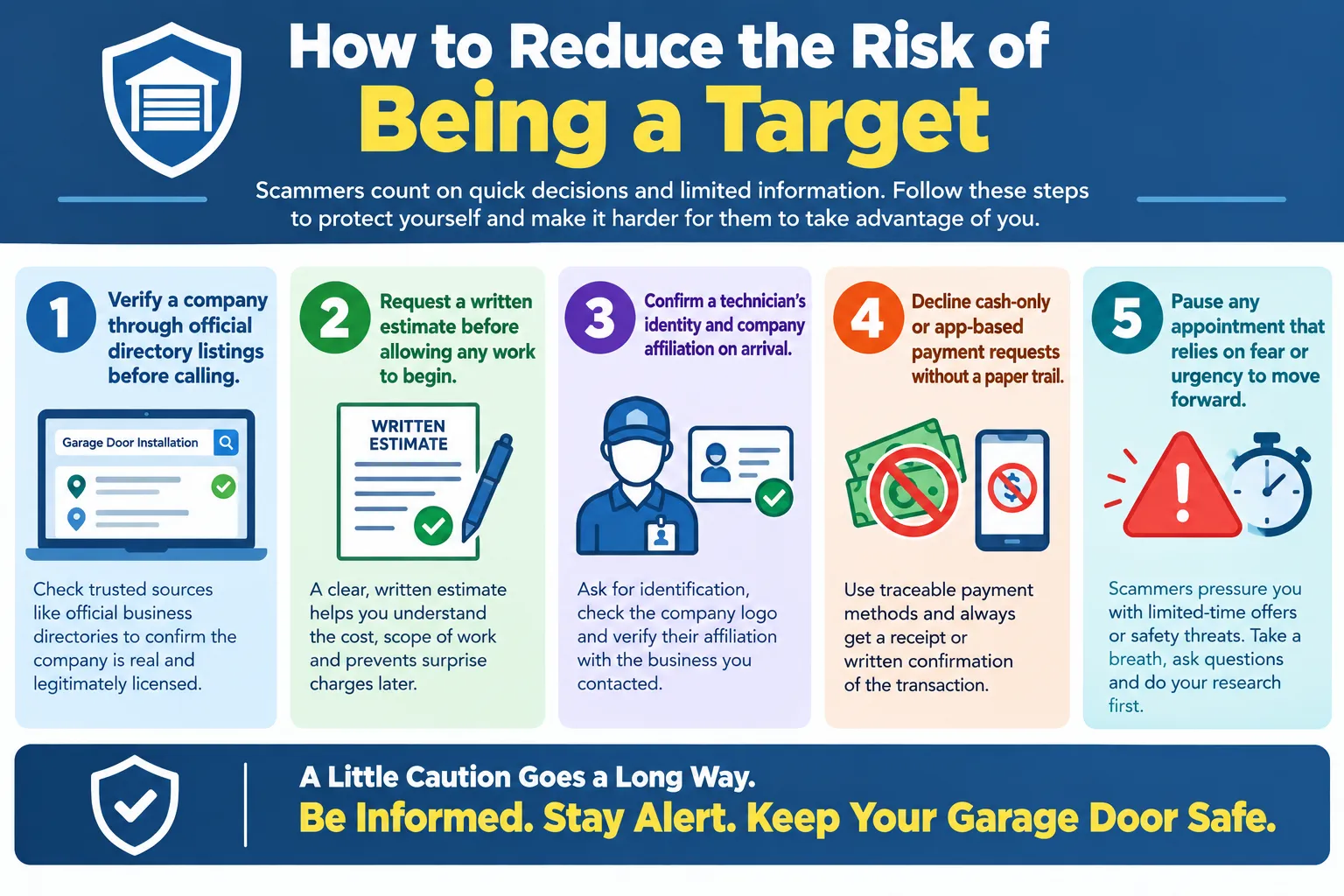
Reducing exposure to these tactics comes down to a short list of habits applied consistently, regardless of how urgent a repair feels in the moment.
These habits close off most of the advantages scammers rely on:
- Verifying a company through garage door installation listings on an official directory before calling.
- Requesting a written estimate before allowing any work to begin.
- Confirming a technician’s identity and company affiliation on arrival.
- Declining cash-only or app-based payment requests without a paper trail.
- Pausing any appointment that relies on fear or urgency to move forward.
A homeowner who applies these habits consistently becomes a far less appealing target than one who reacts quickly under pressure.
Recognizing How Scammers Target Homeowners Is the First Line of Defense
Digital deception, physical anonymity, technical exploitation, and financial pressure work together as one connected system that scammers rely on from start to finish, not as a set of isolated incidents that happen by chance. Breaking that system into recognizable parts lets a homeowner interrupt it before real damage occurs.
ADS Garage Doors & Gates sends identifiable, accountable technicians to every appointment across San Diego, without the anonymity scammers depend on to avoid accountability. Contact us or give us a call today to schedule a visit with a team that welcomes every question before the work begins.