
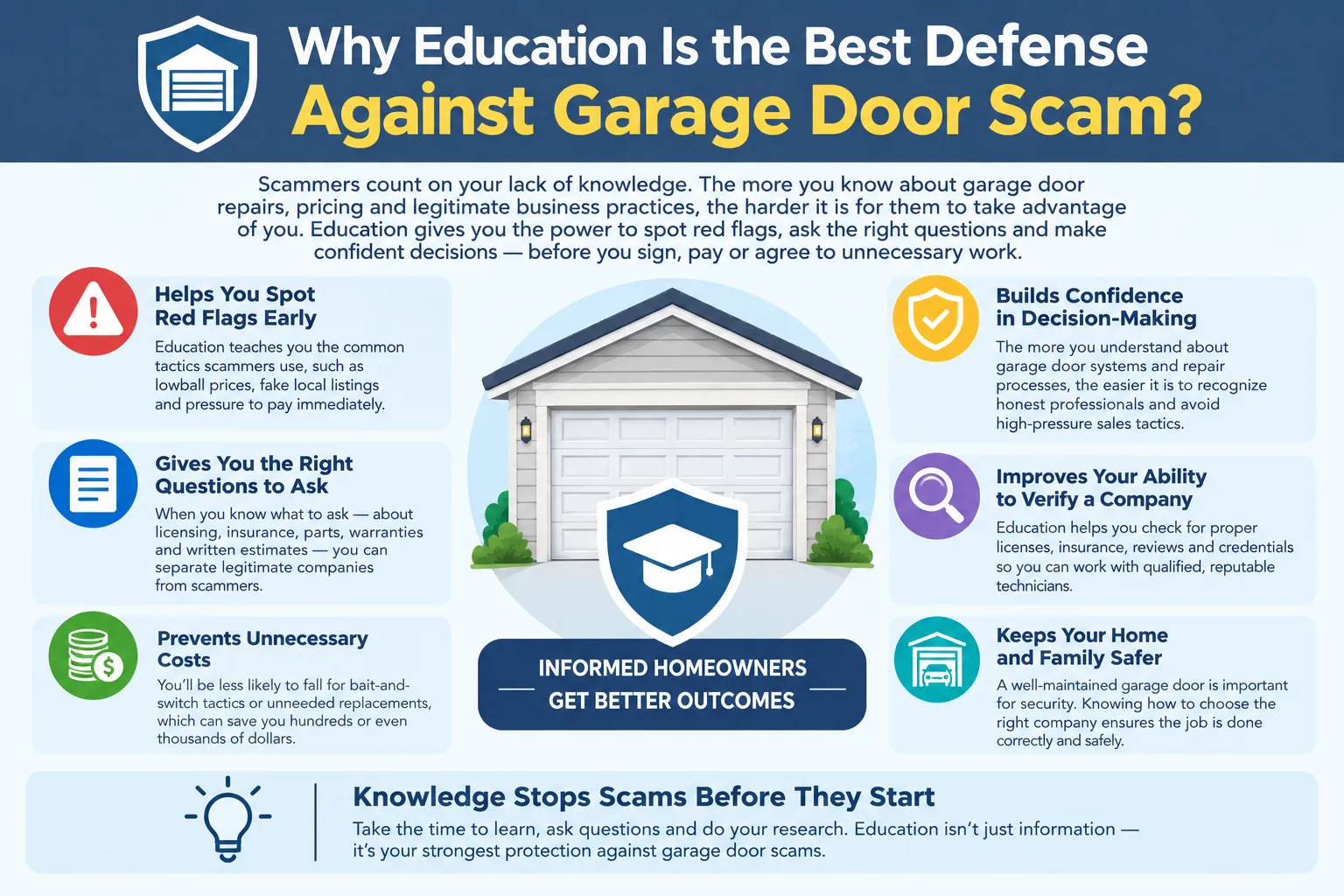
An informed homeowner recognizes a garage door scam long before money changes hands, making education the strongest safeguard against fraud. Fraudulent operators rely on confusion and urgency, and that advantage disappears the moment someone already knows what a legitimate repair looks like.
Scammers thrive when a garage door service call gets booked in a panic, since panic leaves little room to question a diagnosis or a price. This guide breaks down the tactics scammers use, the warning signs worth memorizing, and how knowledge turns the odds back in the homeowner’s favor.
Key Takeaways
- Garage door scammers rely on urgency and unfamiliarity, both of which lose their power once homeowners understand standard pricing and repair practices.
- Warning signs like unmarked vehicles, vague business names, and cash-only demands appear across nearly every reported garage door repair scam.
- Bait-and-switch pricing, scare tactics, and inflated parts claims rank among the most common tactics used against uninformed homeowners.
- Reporting a scam to local authorities or the Better Business Bureau protects other homeowners from the same fraudulent activity.
- Verifying a company before scheduling service blocks most scam attempts before they start.
Common Tactics Used in Garage Door Scams
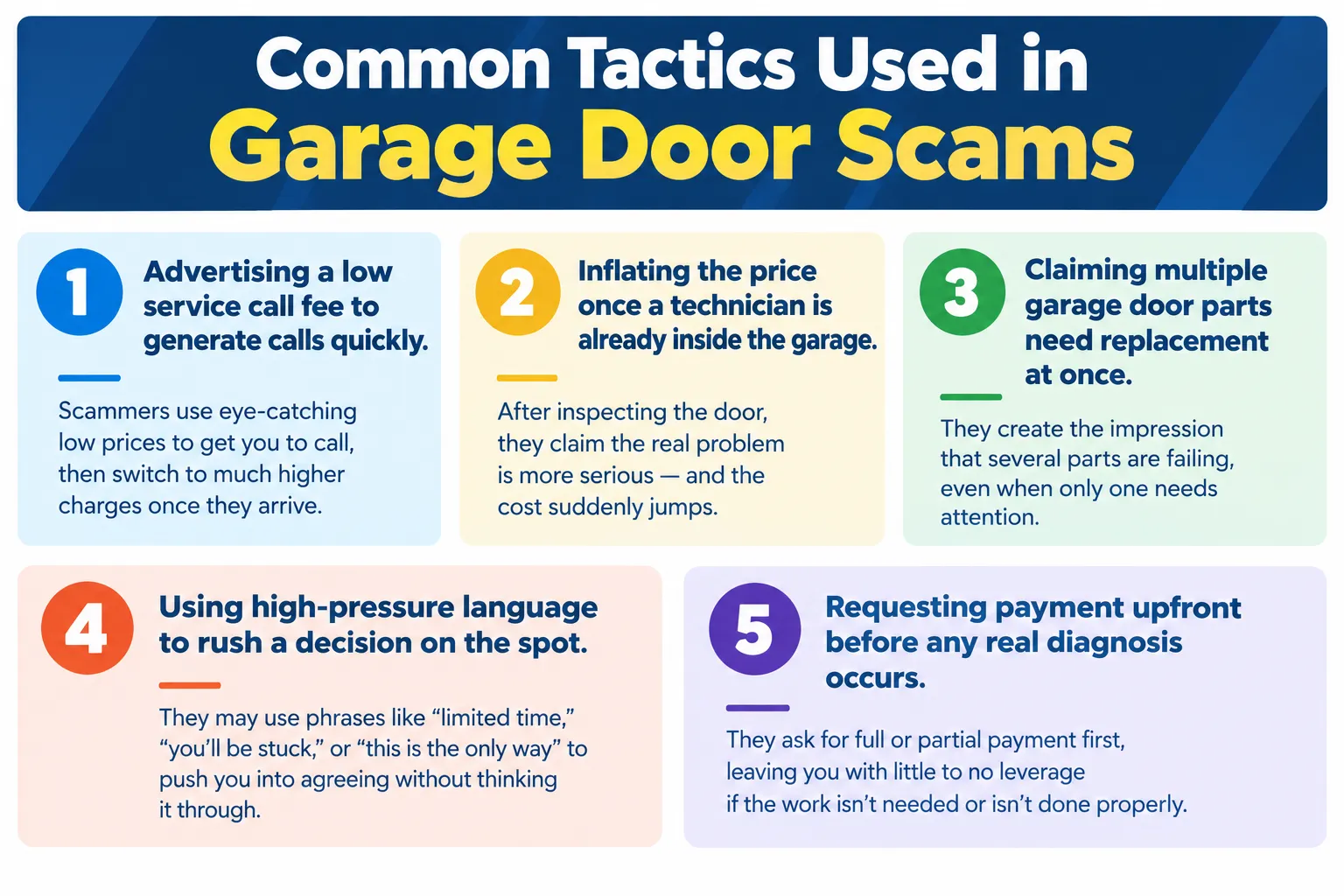
Fraudulent operators rely on a small set of proven tactics because they consistently work against homeowners who have never dealt with a garage door repair scam before.
These tactics show up again and again across reported cases:
- Advertising a low service call fee to generate calls quickly.
- Inflating the price once a technician is already inside the garage.
- Claiming multiple garage door parts need replacement at once.
- Using high-pressure language to rush a decision on the spot.
- Requesting payment upfront before any real diagnosis occurs.
To recognize the specific tactics covered in this cluster and act quickly, read our guide on What Are the Most Common Garage Door Scam Tactics?, which breaks down each one homeowners are most likely to encounter.
Warning Signs of a Garage Door Scam Homeowners Should Know
Noticing the signs of a scam early depends on knowing exactly what to look for before a technician ever steps foot on the property.
Watch for these details before allowing any work to begin:
- No legitimate physical showroom listed anywhere for the business.
- Business names that sound generic or copied from a larger brand.
- Technicians arriving in unmarked vehicles with no visible company branding.
- Pressure to pay in cash or sign paperwork before receiving a detailed estimate.
- Reviews that appear suspiciously uniform or recently posted in bulk.
Two or more of these signs appearing during the same service call is reason enough to pause the appointment before any work begins.
How Scam Tactics Exploit a Lack of Knowledge
Garage door scammers most often succeed against homeowners with no baseline understanding of what a real repair should cost or involve.
The knowledge gap gets exploited in a few consistent ways:
- Quoting inflated service costs that sound reasonable without a comparison point.
- Describing damage to garage door systems in vague, alarming terms.
- Betting that a homeowner will skip double-checking pricing against other providers.
- Counting on the homeowner not knowing what torsion springs actually cost.
- Relying on the stress of an emergency repair to shorten decision time.
To understand why uninformed homeowners get targeted more often than others, read our guide on How Do Garage Door Scammers Target Uninformed Homeowners, which explains the specific traits scammers look for.
The Role Education Plays in Preventing Garage Door Scams
Education changes the outcome of a service call long before a scammer gets the chance to pitch a homeowner.
Scam Tactic | What the Scam Relies On | How Education Neutralizes It |
Bait and switch pricing | A low advertised fee that never matches the final bill | Knowing what a real service call fee typically covers |
High-pressure scare tactics | Fear that delays create serious danger | Understanding which repairs genuinely require urgency |
The parts shell game | Confusion about what parts actually failed | Recognizing common garage door parts and their real cost |
Fake local listings | A polished website standing in for a real business | Knowing how to verify a legitimate business location |
Anonymous technicians | No way to confirm who is doing the work | Requesting identification and a written estimate upfront |
A scam tactic loses nearly all of its power fairly quickly once a homeowner understands exactly what it depends on to work in the first place.
Dismantling “Bait-and-Switch” Pricing
Service fees advertised far below the market rate almost always signal a pricing trap rather than a genuine deal.
A few consistent details usually reveal the pattern:
- Quoted fees that seem disconnected from typical service costs.
- Additional charges introduced only after the technician arrives.
- Vague explanations for why the original quote no longer applies.
- Pressure to accept the new total without a written breakdown.
- No willingness to provide a detailed estimate before starting work.
Understanding what a legitimate service call fee actually includes makes a number that looks too good to be true much easier to walk away from.
Neutralizing High-Pressure Scare Tactics
Fear works fastest and hits the hardest when a homeowner has no independent understanding of how urgent a repair truly is.
Knowing these facts ahead of time makes a calmer response possible:
- Most garage door issues do not pose an immediate safety threat.
- Snapped springs are dangerous to handle, not dangerous to leave briefly.
- Getting a second opinion rarely makes the situation worse.
- Scare language often exaggerates risk to speed up a decision.
- Pausing to verify a claim almost never leads to further damage.
Staying calm during a high-pressure pitch buys enough extra time to question a diagnosis calmly instead of accepting it outright.
Exposing “The Parts Shell Game”
Dishonest technicians frequently claim several garage door parts need work at once, even when only one small adjustment is actually necessary.
Challenging this tactic comes down to a short set of questions:
- Ask to see the specific parts described as damaged or worn.
- Request a written, itemized estimate before agreeing to any repair.
- Compare the quoted price against typical garage door replacement parts and labor costs.
- Question why multiple systems would fail during a single visit.
- Confirm the parts are professional quality, not consumer-level DIY-market parts, such as a Chamberlain opener from Home Depot or Costco in place of a LiftMaster.
Technicians who avoid these direct questions or grow visibly impatient with them are rarely working from an honest diagnosis.
Recognizing Virtual “Imposter” Listings
Out-of-area call centers frequently buy up local search placement using generic names designed to resemble an established local business.
These details tend to expose an imposter listing:
- Business names that sound interchangeable with dozens of others.
- No verifiable physical address tied to the company.
- Reviews concentrated in a short window rather than spread naturally.
- Phone greetings that never mention a specific local office.
- Search results that rank high without any real community reputation.
Checking a company against an official directory takes only a few minutes and confirms whether the business is real before scheduling anything.
Stripping Away Anonymity
Scammers depend on staying anonymous, since technicians with no name, uniform, or paperwork are much harder to hold accountable afterward.
Removing that advantage comes down to a few simple boundaries:
- Requesting the technician’s name before scheduling the appointment.
- Confirming the vehicle arriving matches the company’s actual branding.
- Asking for identification before allowing entry to the garage.
- Getting a written estimate with the business name clearly listed.
- Declining any request for payment before fully explaining the work.
Anonymity only works if it goes unquestioned, and a few direct questions usually end it before a scam can proceed any further.
How Reporting a Garage Door Scam Helps Educate the Community
Reported scams do more than resolve one bad experience, since they give local authorities and future homeowners a documented pattern to watch for.
Filing a report accomplishes several things at once:
- Adding the incident to a BBB scam tracker other homeowners can check.
- Alerting local authorities to a company operating under fraudulent activity.
- Warning neighbors through reviews before the same company reaches them.
- Creating a paper trail if legal action becomes necessary later.
- Helping legitimate garage door repair companies stand out from scammers.
To learn exactly how a single report turns into community-wide education, read our guide on How Does Reporting a Scam Help Educate Other Homeowners, which walks through what happens after a report gets filed.
How to Put Garage Door Scam Education Into Practice
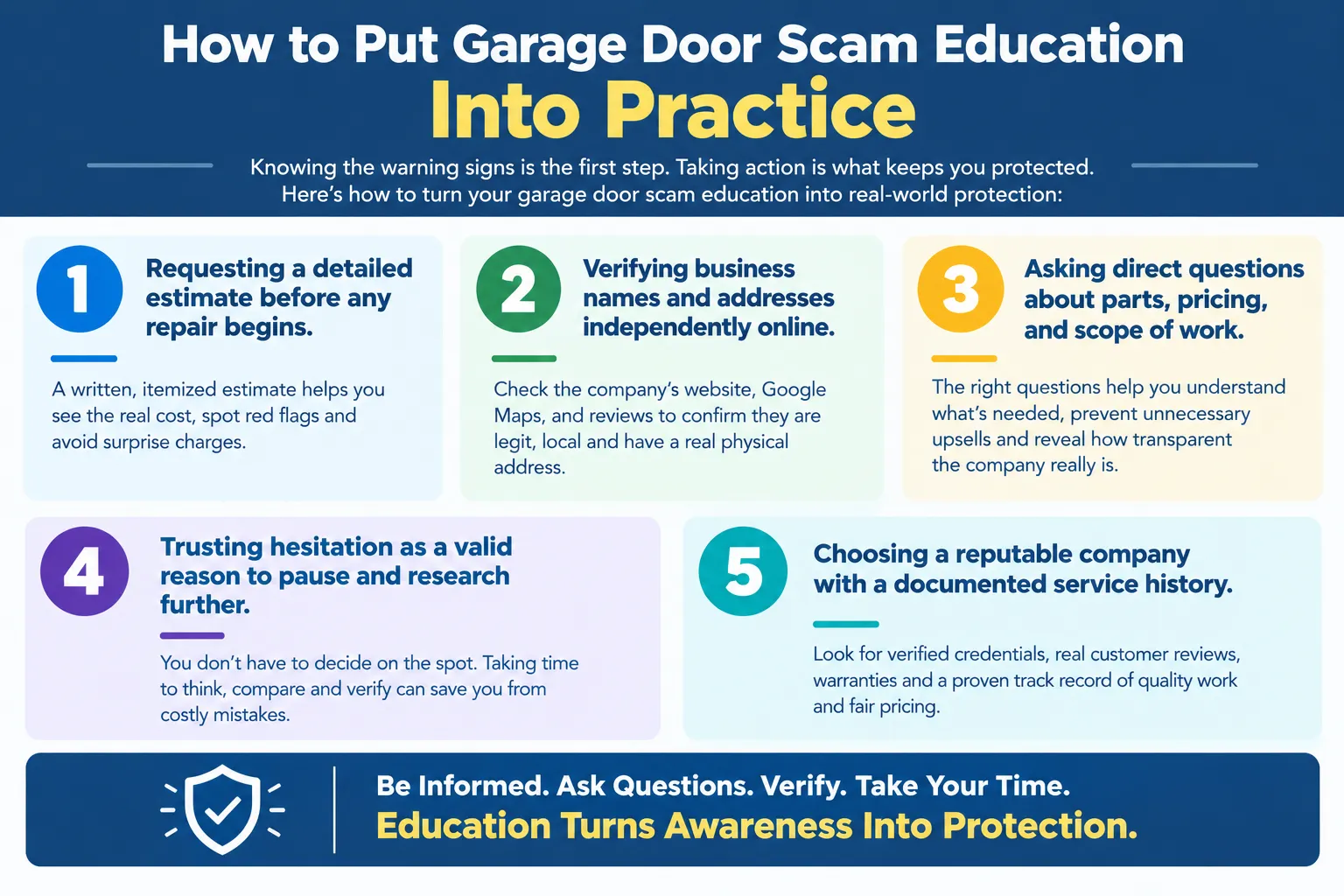
Applying awareness in real life means building a short, dependable list of habits for every garage door installation or repair service.
These habits keep education working in the background of every decision:
- Requesting a detailed estimate before any repair begins.
- Verifying business names and addresses independently online.
- Asking direct questions about parts, pricing, and scope of work.
- Trusting hesitation as a valid reason to pause and research further.
- Choosing a reputable company with a documented service history.
Treating these habits as routine over time makes scam awareness feel automatic rather than something to think about on every call.
Education Is the Deciding Factor in Every Garage Door Repair Decision
A scammer depends on one thing above all else to make the plan work: a homeowner not knowing enough to ask the right question at exactly the right moment. Closing that knowledge gap through basic education turns a vulnerable, high-pressure situation into a far more manageable and noticeably less costly one.
ADS Garage Doors & Gates trains every technician across San Diego to work with full transparency, from the first phone call through the final written invoice. Contact us or give us a call today to schedule a service visit with a team that genuinely has nothing to hide and welcomes every question asked.