
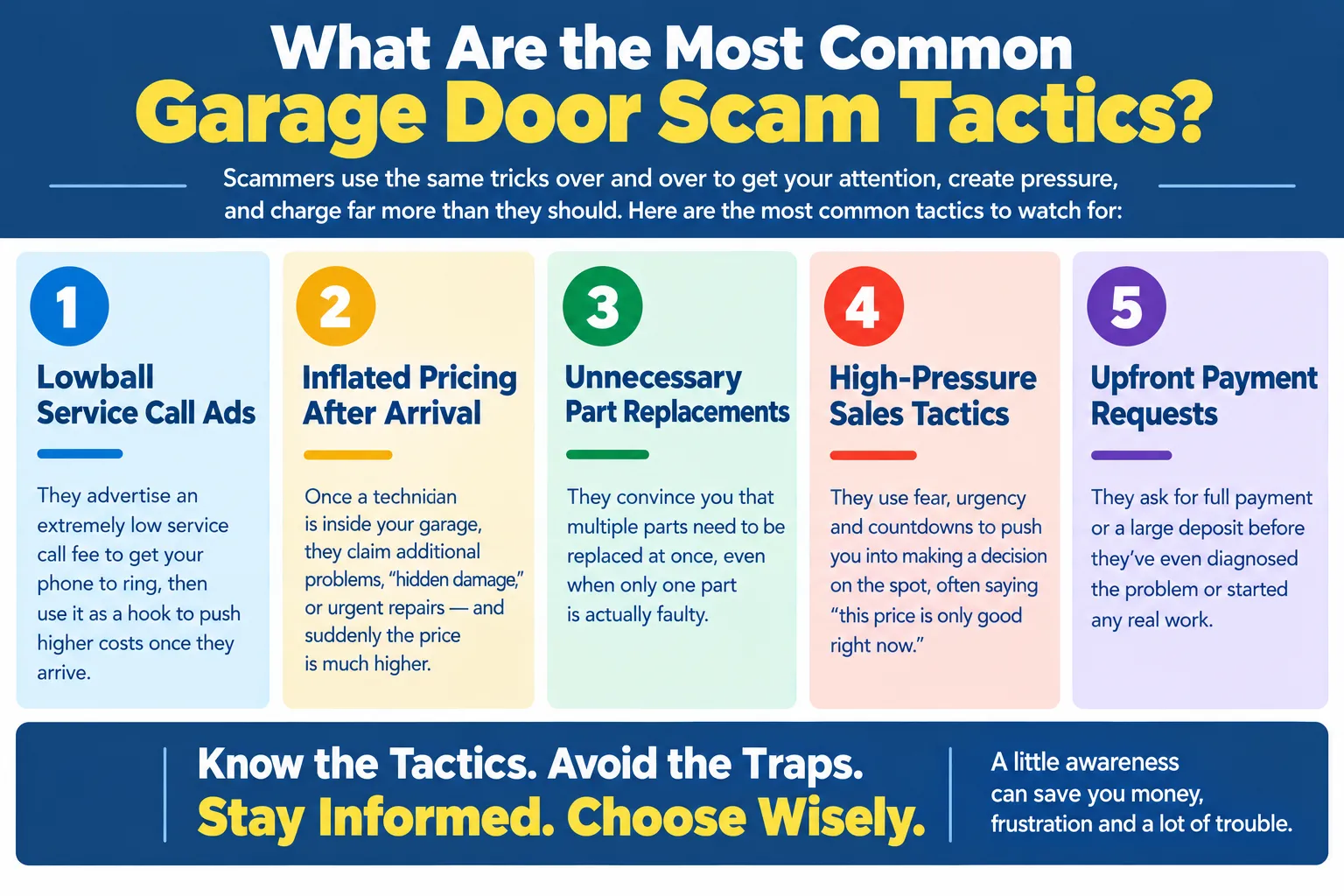
The most reported garage door scam tactics include bait pricing, inflated repair claims, fear-based pressure, fake local listings, and payment demands designed to avoid a paper trail. Knowing what each tactic looks like in practice makes it far easier to walk away before any money changes hands.
A rushed garage door service appointment gives dishonest operators exactly the opening they need to push a tactic through without resistance or delay. This guide breaks down the specific tactics reported most often, walking through exactly how each one plays out from the very first contact to the final bill.
Key Takeaways
- Low advertised fees often serve as bait for a much larger bill once a technician gains access to the garage.
- Fear-based pressure tactics work by removing the time a homeowner would otherwise spend getting a second opinion.
- Fake local listings and unmarked vehicles make it difficult to confirm who is actually doing the work.
- Cheap replacement parts and vague warranties often lead to repeat service calls within months.
- Cash-only or app-based payment demands remove the ability to dispute a charge later.
The Playbook Behind Common Garage Door Scam Tactics
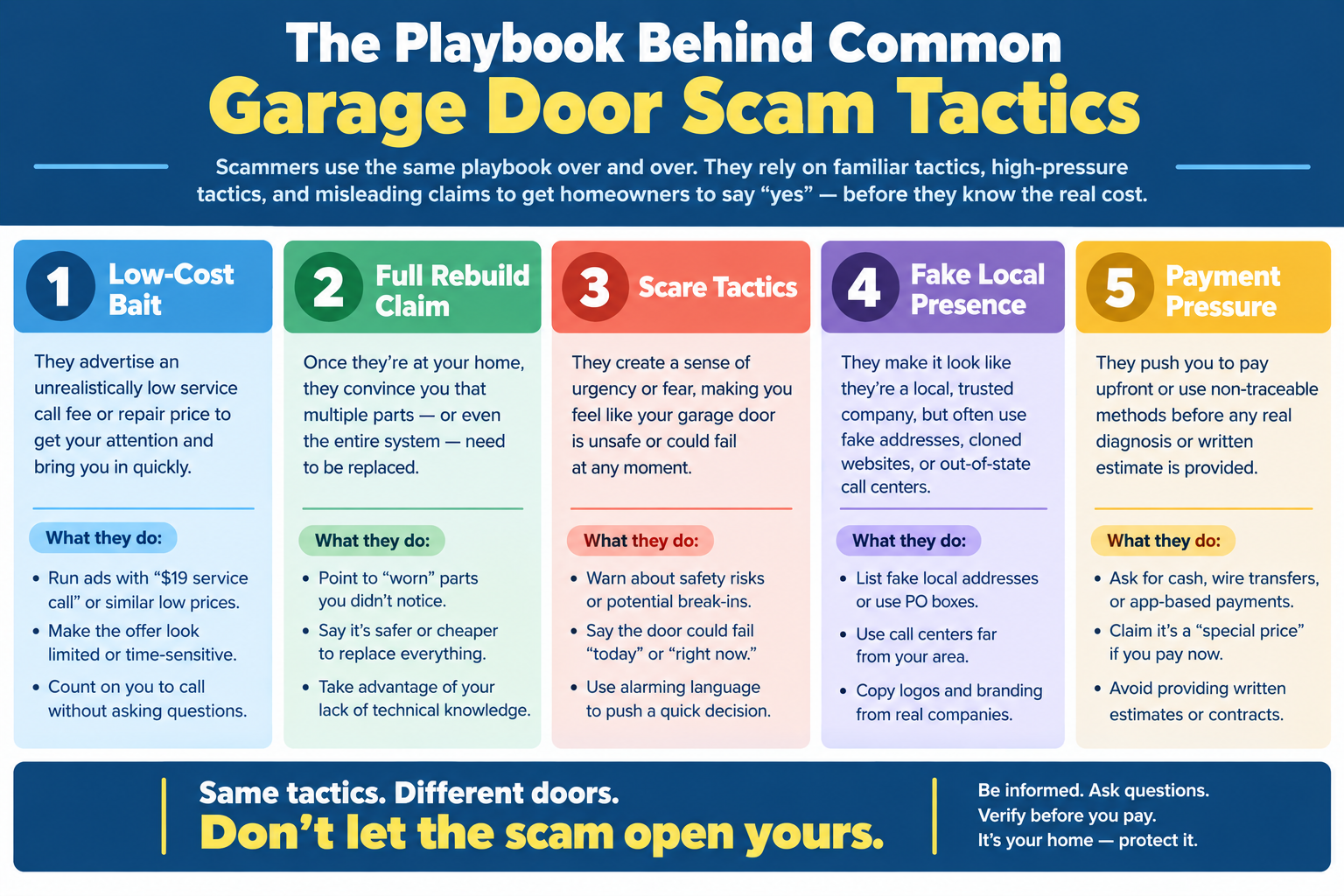
Dishonest operators tend to follow a repeatable sequence, starting with a low-cost hook and ending with a payment method that leaves no trail to follow later.
Tactic | What Happens | Why It Works |
Low-cost bait | A cheap tune-up or service fee gets advertised | A low number removes hesitation before scheduling |
Full rebuild claim | Multiple parts get declared faulty at once | Bundled damage sounds more urgent than one repair |
Scare tactics | The door gets described as dangerously unsafe | Fear shortens the time spent questioning a diagnosis |
Fake local presence | A polished listing hides an out-of-state operation | Search rankings feel trustworthy by default |
Payment pressure | Cash or app-based payment gets demanded upfront | Untraceable payment removes any dispute option |
A brief pause to ask one direct question about pricing or parts costs almost nothing but often saves hundreds of dollars by the time the job is done.
The Low-Cost Service or Tune-Up Trap
A cheap advertised fee, often $29 or $39, exists mainly to get a technician through the door rather than to reflect real service costs.
These details tend to appear once the low-cost bait works:
- Advertising a tune-up or inspection far below typical service costs.
- Dismantling parts of the door before quoting any additional work.
- Introducing urgent repairs only after gaining full access to the garage.
- Adding trip fees or disposal charges not mentioned in the original ad.
- Presenting the new total as non-negotiable once work has started.
Knowing what a real service call fee typically covers makes a number that looks too good to be true far easier to question.
The Full Rebuild Scam
Technicians sometimes look at one broken garage door spring and immediately claim an entire hardware system needs replacing.
A homeowner facing this claim can watch for these signs:
- A diagnosis that expands from one part to several within minutes.
- No clear explanation for why multiple components failed together.
- Reluctance to show the specific parts described as damaged.
- Pricing bundled into one package instead of itemized by part.
- Pressure to approve the full package before a second opinion arrives.
Requesting a written, itemized estimate before agreeing to any bundled repair closes off much of this tactic’s effectiveness from the start.
Exaggerated Safety Scare Tactics
Fear-based pressure works by convincing a homeowner that any delay could result in serious injury or property damage.
These scare tactics show up consistently across reported cases:
- Warning that a door could snap and injure someone at any moment.
- Claiming a spring under tension is dangerous even if left alone briefly.
- Framing a routine repair as an emergency requiring same-day payment.
- Discouraging a second professional opinion by claiming the risk will worsen.
- Using urgency to prevent comparison shopping against other providers.
To understand why staying calm under this kind of pressure works so well, read our guide on Why Education Is the Best Defense Against Garage Door Scam?, which explains how awareness interrupts fear-based tactics like these.
Geographic Ghost and Fake Local Companies
Fraudulent operations frequently build fake local listings using ghost addresses and phone numbers that route straight to out-of-state call centers.
These details often expose a geographic ghost operation:
- No verifiable physical address listed in an official directory for the company.
- Reviews that appear in a short, unnatural burst rather than gradually.
- Phone greetings that never mention a specific local office by name.
- Technicians arriving in unmarked vehicles with no company branding.
- Business names that sound generic or copied from a larger, real brand.
To trace how this same fake-local pattern is used to target uninformed homeowners, read our guide on How Do Garage Door Scammers Target Uninformed Homeowners, which explains exactly how that targeting works.
Mystery Part Markups and Cheap Hardware
Dishonest technicians often charge premium prices while installing generic, wholesale-grade components instead of the parts they claim.
Watch for these details when a part replacement gets proposed:
- Pricing that sounds far higher than typical garage door replacement parts and labor combined.
- Refusal to show the actual part being installed before the work begins.
- Vague brand or model names that cannot be verified afterward.
- Hardware that fails again within a few months of installation.
- Reluctance to provide a receipt listing the specific part used.
Asking to see the exact part before installation removes most of the room a dishonest technician has to substitute cheaper hardware.
The Vague “Lifetime Warranty” Deception
A lifetime warranty offered verbally during the sales pitch often applies only to a single cheap part, not to the labor required each time it fails.
These details usually reveal a warranty built to fail:
- No written documentation of what the warranty actually covers.
- Fine print limiting coverage to the part alone, not labor charges.
- Repeat service calls needed within months of the original repair.
- Vague answers when asked to clarify the exact warranty terms.
- Pressure to accept the warranty verbally instead of in writing.
Requesting the warranty terms in writing before agreeing to any repair exposes this tactic almost immediately and saves real money in the long run.
Cash-Only or Upfront Payment Demand
Insisting on cash or an unreversible app payment before finishing a repair removes any paper trail a homeowner could use to dispute a bad job later.
These payment demands appear frequently across reported scam cases:
- Claiming a card reader or payment system is temporarily broken.
- Requesting payment through apps that cannot be reversed or disputed.
- Asking for a check written to a personal name instead of the business.
- Demanding full payment before the job has actually been completed.
- Avoiding any receipt or documentation tied to the transaction.
To report a payment demand like this before it becomes part of a larger pattern, read our guide on How Does Reporting a Scam Help Educate Other Homeowners, which walks through what a report can accomplish afterward.
How to Respond to These Tactics in the Moment
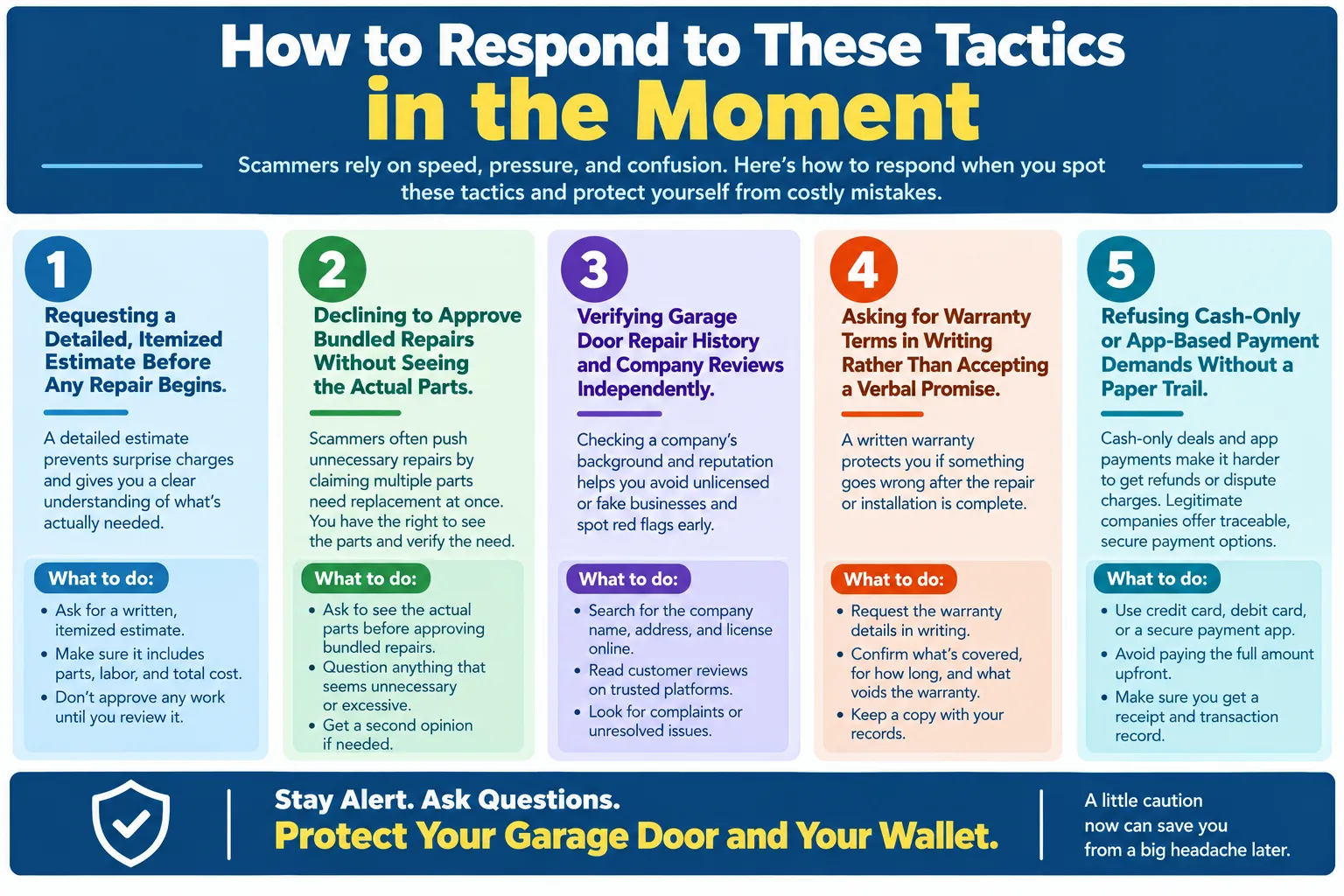
Responding well in the moment comes down to a short list of habits that apply regardless of which tactic shows up first.
These habits work across nearly every tactic covered above:
- Requesting a detailed, itemized estimate before any repair begins.
- Declining to approve bundled repairs without seeing the actual parts.
- Verifying garage door repair history and company reviews independently.
- Asking for warranty terms in writing rather than accepting a verbal promise.
- Refusing cash-only or app-based payment demands without a paper trail.
Applying these habits consistently turns nearly any tactic covered here into a far less effective one against a homeowner who already knows what to expect.
Knowing These Tactics Well Is the Best Defense Against Them
Bait pricing, inflated diagnoses, fear-based pressure, fake listings, and payment tricks all rely on the same two things working together: a rushed decision and a homeowner who never stops to verify anything. Removing either one from the equation is often enough to stop a scam before it gets very far past the first phone call.
ADS Garage Doors & Gates gives homeowners across San Diego a written, itemized estimate before any repair begins, without pressure, hidden fees, or vague explanations. Contact us or give us a call today to schedule service with a team that explains every part of the job clearly and upfront.